Showing posts with label Arctic. Show all posts

Saturday, May 15, 2010

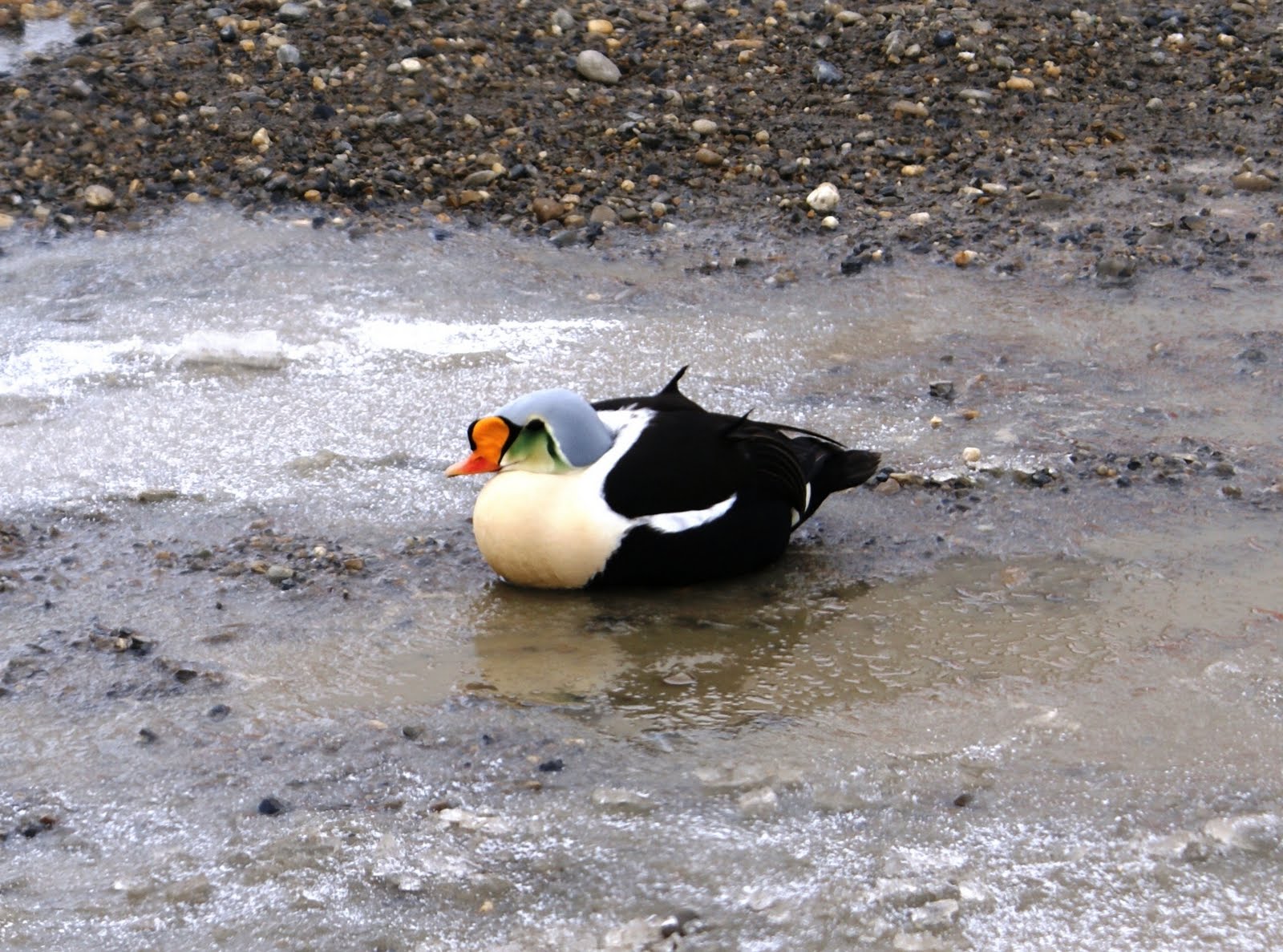
The Sad Little Duck


“The Sad Little Duck”

The attractive little fellow pictured is a King Eider duck. One of the 258 species of birds that spend the summer in the Arctic, giving birth to new generations. The unfortunate truth this year is the birds returned to their birth place a little too early. The North Slope is still covered in ice and snow and is very slow to turn into the normal spring the birds are accustomed to. This photo was taken yesterday and most likely he has already fallen victim to the hunger pains of the Raven or perhaps a red, or arctic fox. Mother Nature can be cruel and in the arctic it is demonstrated on a regular basis.

Sunday, September 20, 2009

Its Official


It is official indeed. Winter has arrived on the North Slope. Our first good dusting of snow is on the ground and temperatures are dropping. The kicker for the change in season was the large flock of Tundra Swans flying over at about 10:15 a.m. I have to admit that I just wasn't ready for the shot. My camera was tucked away in it's bag. The photo sucks because of the distance. When I realized that they were swans, it was just to late. Anyway, to those in North Carolina and Chesapeake Bay area, heads-up. They are on there way. You should see them in early November. The Swan is the last migrating bird to leave the slope. It is a struggle at times watching a handful of parent swans trying to encourage their young to reach goals set by mother nature. When the time comes, and the young for what ever reason has not met those goals, they are left behind as food for the hungry fox. That is what nature is all about.

Tuesday, May 26, 2009

Toby Jr. Takes A Break


What’s the difference between a grizzly bear and a brown you ask? Not a lot really. The browns live in areas closer to the coast and are a little larger then the higher elevation grizzlies, such as the ones that live in Montana. They are both best left alone. The polar bear is considered a marine mammal and of course lives by a whole different set of rules set down by Mother Nature. Much of the focus that centers around climate change, is based on the effect that it is having on the polar bear. It is true that climate change is taking place and it is having an effect on all species. Climate change is not new however. The area in Alaska that I work in, was once a tropical forest. It is still in question what effect man has on the process. The bottom line is that the polar bear will adapt to changes in the climate if not by mutation, then by adapting by breading with the brown bear which it has already done. It is just my opinion of course but I do see this as the new order of things. I would imagine that what you end up with is a bear more capable of surviving in more adverse conditions then before. The hunting skills and abilities of both animals. This is Mother Natures way. The photo was taken a few years ago and I admit the quality is less then perfect. It was a long shot with my 75 X 300 maxed out. This particular bear was alleged to be the off spring of the North Slopes most famous bears, “Toby.” Toby was one of the last character bears on the slope. He was smart, very smart and had grown up dealing with the security personnel. He knew exactly how far he would have to go into the tundra to avoid the cracker rounds. Toby would then just lay down and look at us knowing he had won. Toby was shot and killed after charging a group of people in the Prudhoe Bay Hotel a few years ago. This was after he had broke into the second story fire escape looking for some food. His death was reported on CNN and we all felt the loss. His offspring , like the one above, still roam the tundra.

Tuesday, May 19, 2009

Polar Bear in the Cotton


I am ashamed of myself for not posting this photo earlier. It is one of my favorites. I took this back in 2004 I think, in September. One of our functions as security is to monitor bear activity and report to the feds. We are also all trained and certified by the Department of Wildlife to haze both brown and polar bears on the Prudhoe Bay oil field. By hazing I don’t mean getting them drunk and making them pick up marshmallows with their butt cheeks. By hazing I mean making them change direction by honking a horn, a short blast on the siren and at times cracker shells. These are launched in the direction of the bears from a shotgun and a small explosion occurs letting them know they need to go the other way. This is a last resort especially with the polar bear. As a rule they will visit the field and just rest in a location for a day or two then move on usually back to thee ocean. For all of us that have been assigned to sit and keep an eye on polar bears, I can tell you it is a privilege to see these beautiful creatures up close, (but not too close) in their natural surroundings. The oil companies go to great lengths to avoid disturbing them. An example would be the ice roads that are built every winter cannot be within a one mile distance of a den containing a female bear and her cubs. The pregnant female dens in the winter on shore to give birth.
The bear is the photo was a female approximately three years old. Most likely just kicked out on her own by her mother. I was observing this bear and while doing so, I was listening to Bruce Hornsby’s CD, Halacon Days,” which had just been released. The music was great and I sent a note with the photo to his web site and explained the circumstances. I never thought I would hear back from him but I received a note via e-mail, “I didn’t know I was writing polar bear sound track music, but I love it!” The photo and our exchanged was on the front page of his web site for a year. A short time after this happened I saw Bruce in concert in Baltimore, while taking a vacation on the east coast.

Saturday, March 28, 2009

No Thanks


One can never be surprised by what you will see on the North Slope. These photos were taken on Sept. 27th 2007. The Ranger is equipped with a water tank and a very long boom with a nozzle attached. It is controlled by a door operator. It is used to clean power line insulators to help prevent shorts in the lines. If it looks like a dangerous job I can tell you that it is. This very Helicopter crashed on the oil field about two weeks after I took these photos. The pilot was seriously injured and the doorman suffered some injuries as well. This particular process was developed for use on the slope but can now be seen being used all over the world.

Sunday, February 22, 2009

Jeff Foxworthy, Eat Your Heart Out


Jeff Foxworthy, eat your heart out!
OK, this not really a redneck mansion. It is a rig camp on the North Slope used to house workers for its assigned rig. The rigs are moved from one location to the next for exploration or reworking old well sites. They move often and when they do the workers follow them with these self contained camps. It is interesting to note that while these camps are on the move, either the night or day shift workers will in fact be on board sleeping.

RJ Cole

Saturday, February 21, 2009

Just Another Alaska Sunrise


This photo was taken today at about 09:23. The temp was a muggy minus 30. This time of year we see this almost daily and the sunsets can be pretty spectacular as well.

Image by Randy J. Cole

Sunday, February 15, 2009

Arctic Cotton


September of 2003, the sun is just right while I was on patrol. The Arctic Cotton which grows on the tundra during the summer, glows like gold as it bathes in the final days of sunlight.

Image by RJ Cole

Friday, November 7, 2008

Undaunted


Tundra grass gone to seed, drifting in the wind like a long lost lover,
roots buried deep in the arctic soil, holds them steadfast, no need for cover.

They hold on tight to the soil, even as the cold snaps to 60 below,
wind bends them to the breaking point, frozen and covered in snow.

Spring comes in June; the seeds that stayed dormant will spread,
creation of a green homeland, for the feathered ones that nature has led.

What lessons can we find in the tundra grass that grows in a hostile land unwanted,
from this simple plant that overcomes the harsh, and continues life, undaunted.

Words and Images by Randy J. Cole
Photo location: Sand dunes near arctic ocean, Prudhoe Bay Oil Field

Friday, October 3, 2008

Winter Comes


Winter arrived on the North Slope today. It arrived on the wings of 30+ mph winds. If this is any indication, it will be a long tough winter. It was as though someone turned on a light switch. Sadly, I know that many of the young tundra swans were not ready for the change. The parents will follow there instincts and head south, leaving their young to the mercy of Mother Nature. How painful that must be. You know they must feel the pain as they are a loving creature. They mate for life and will not take on another mate if death should separate them. The loss of their young would be unbearable. Next year, we will look up toward the vast Alaska sky; we will see the pairs of swans return to continue the cycle. It is truly an amazing story in the book of life.

Saturday, August 23, 2008

Crapper in a Wrapper


About four years ago I snapped this shot of a porta-potty that had been delivered to the Central Check Point on Prudhoe Bay. The toilet inside the check point was in-op at the time. So, the mystery is solved about where one might do a nature call in 60 below zero weather in the Arctic.

Wednesday, July 30, 2008

Some Color for the Page

I decided that maybe a little color from the slope might be nice. This little batch of flowers are loctated in the parking lot area of the Alaska Airlines termanal in Deadhorse. This is the airport that serves passengers traveling to the North Slope of Alaska. These are known as, "River Beauty."


Little closer view for you flower lovers.

Sunday, July 20, 2008

Unique


Unique

I thought I would share some more things about the North Slope that might interest you. The North Slope is the largest borough, or county, in size (not population) in the United States with an area mass of just under 90,000 square miles. The population is somewhere between 7000 and 9000 people. This does not count the oil field workers in Prudhoe Bay, which is within the North Slope jurisdiction. The borough has a camp in Deadhorse, which houses the government agencies. One such agency is the NSB Police Department. I worked for this agency for 10.5 months back in 2001 but left for employment with a private company after 9/11. Here are a few photos which depicts the NSB’s standard patrol vehicle. The thing that set the vehicle aside is the very unique emblem of the department. It really does capture the soul of the North Slope. I look forward to sharing more unusual things found in this part of Alaska.


This graphic has got to be one of the most interesting ever to be placed on a law enforcement vehicle.

All images by Randy J. Cole


Monday, July 14, 2008

A Day on the Slope


A caribou strolls along a small lake near the main road, under the watchful eye of waterfowl.


Every summer, tourist arrive by the bus loads to dip their toes into the Beaufort Sea (Arctic Ocean.) This spot is the only access where they can fulfill their desires. The area is known as East Dock and is within the controlled access area of the Prudhoe Bay oil field. Many people go a step further with total submersion. Cloths are optional. To visit this site you must arrange a tour with the private tour company located in Deadhorse, just off the oil lease property. Holland America and Princess Cruise Lines both have regular tours to this location and upon thier arrival on the slope are handled by the same tour company. Would you believe that the numbers this year for those coming on the oil field for a tour will top 8000 between May 15Th and September 15Th. For more info about the tours let me give you this number. 907-659-2368. and the web site, http://www.arcticcaribouinn.com

After 9/11, I was directly involved in the tours for two years. It was amazing to see people arrive with so many negative ideas about the oil industry. After seeing the standards in place that we must abide by, and seeing first hand just how clean this place is, most walked away with a different point of view.


Sand dunes in the Arctic? Yep, and they are hundreds of years old. The sand is blown to this area from the Sagvanirktok River Delta. They are located just off the main road which takes you to the East Dock area. They are for viewing only. No personnel is allowed to walk on the tundra or any area such as this, without being allowed to do so by the BP Environmental Department. This requires a permit process.

Geese and other waterfowl are everywhere. This year it seems like there are more birds then ever. It is one of the highlights of being on the slope. Watching the animal life do its thing.

All images by Randy J. Cole

Friday, March 28, 2008


Invisible Artist

I took this photo October of 2006 in the window of the camp that I call home, while working on the North Slope in Alaska. I took the photo hoping to catch the orange glow in the frost from the setting sun, which during this time of year is not visible for very long. It was not until I downloaded the photos onto my laptop, that I discovered the images of two hummingbirds in the frost. The images appeared on the inside pane of a double pane window. Very strange indeed. I would love to receive some comments on this one.


Randy J. Cole